
Google Ads can help your business reach customers almost instantly, but success doesn’t come from simply launching a campaign. Without the right strategy, even a healthy advertising budget can produce disappointing results.
If you’re wondering whether PPC management services are worth the investment, this guide explains what they do, when they’re valuable, and how to decide if they’re the right fit for your business.
What Does PPC Stand For?
PPC stands for pay-per-click, a digital advertising model where businesses pay only when someone clicks on their ad. It allows companies to appear in sponsored search results on platforms like Google Ads, Microsoft Advertising, and social media, giving them immediate visibility while targeting users actively searching for their products or services.
PPC also gives businesses precise control over their advertising. Advertisers can choose keywords, define target audiences, set budgets, and track performance through metrics like clicks, conversions, and return on ad spend (ROAS). This real-time data makes it easier to optimize campaigns, reduce wasted spending, and improve overall marketing performance.
What is the Purpose of PPC?
The primary purpose of PPC is to help businesses reach potential customers at the exact moment they are searching for relevant products or services.
Unlike traditional advertising, which targets broad audiences, PPC focuses on user intent, allowing businesses to appear prominently in search results for high-value keywords. As a result, it can generate immediate visibility while supporting measurable business objectives.
Businesses use PPC campaigns to:
- Generate qualified leads
- Increase online sales
- Promote seasonal offers and limited-time campaigns
- Build brand awareness
- Drive local traffic
- Test new products or services
Another significant advantage of PPC is its measurability. Businesses can track impressions, clicks, conversions, cost per acquisition (CPA), and return on ad spend (ROAS) to evaluate campaign performance. These insights make it possible to refine targeting, optimize budgets, and improve results based on real-world data rather than assumptions.
What You’re Really Paying for With PPC Management Services
Many people assume PPC management services only involve creating advertisements. In reality, launching a campaign is just the first step.
Professional PPC managers continuously refine campaigns through tasks such as:
- Keyword Research: Identifies the search terms potential customers use to help ads appear in relevant search results
- Competitor Analysis: Evaluates competitors’ advertising strategies to uncover opportunities and improve campaign performance
- Audience Targeting: Defines who sees the ads based on factors such as location, demographics, interests, or search intent
- Ad Copy Optimization: Improves ad headlines and descriptions to increase click-through rates and conversions
- Bid Adjustments: Modifies bids based on factors like device, location, audience, or time of day to maximize return on ad spend
- Negative Keyword Management: Excludes irrelevant search terms to reduce wasted ad spend and improve traffic quality
- Conversion Tracking: Measures actions such as purchases, form submissions, or phone calls to evaluate campaign effectiveness
- Landing Page Recommendations: Suggests improvements to landing pages to create a better user experience and increase conversion rates
- Performance Reporting: Analyzes campaign metrics and trends to measure results and identify opportunities for ongoing optimization
Digital advertising is constantly changing. Search trends shift, competitors adjust their strategies, and customer behavior evolves throughout the year. Keeping pace with these changes requires continuous campaign optimization to maintain performance and control advertising costs.
Signs Your Business Could Benefit From PPC Management Services
Not every business needs outside management. Still, certain situations make professional support a worthwhile investment. You may benefit from PPC management services if:
- Your campaigns receive clicks but few conversions.
- Advertising costs continue to rise.
- You don’t have time to manage campaigns consistently.
- You’re entering a highly competitive industry.
- You’re running campaigns for multiple services or locations.
- You’re unsure how to interpret campaign data.
Professional management can also benefit businesses with larger advertising budgets. Even small improvements in campaign performance can significantly increase overall return on investment.
All Scapes Marketing helps businesses maximize every advertising dollar through strategic PPC management, ongoing campaign optimization, and data-driven decision-making. By focusing on measurable outcomes instead of vanity metrics, the team helps clients generate more qualified leads and improve long-term marketing performance.
Are PPC Management Services Worth It?
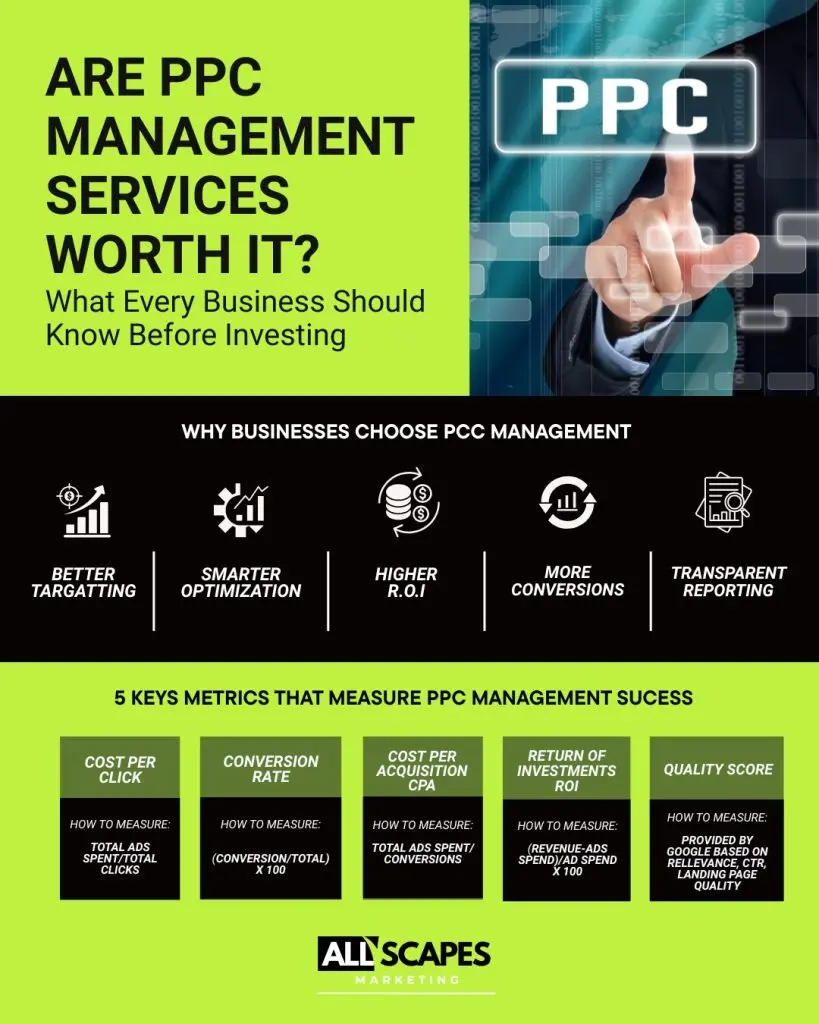
The success of a PPC campaign shouldn’t be measured by clicks alone. Instead, businesses should focus on metrics that directly reflect performance, including:
Cost Per Click (CPC)
Cost per click (CPC) measures the average amount you pay each time someone clicks on your ad. It is calculated by dividing your total advertising spend by the total number of clicks.
A lower CPC generally means you’re attracting traffic more efficiently, but it should be evaluated alongside conversions. If your CPC is low but leads or sales remain limited, your targeting or keywords may need refinement.
Conversion Rate
Conversion rate measures the percentage of ad clicks that result in a desired action, such as a purchase, phone call, or form submission. It is calculated by dividing the total number of conversions by the total number of clicks and multiplying the result by 100.
A higher conversion rate indicates that your ads are attracting the right audience and that your landing pages effectively encourage visitors to take action.
Cost Per Acquisition (CPA)
Cost per acquisition (CPA) measures how much you spend to generate one customer or lead. It is calculated by dividing your total advertising spend by the number of conversions.
A lower CPA generally indicates better campaign efficiency, provided the cost aligns with your profit margins. If CPA continues to rise, it may signal that your targeting, bidding strategy, or landing pages need improvement.
Return on Investment (ROI)
Return on investment (ROI) measures whether your PPC campaigns generate more revenue than they cost to run. It is calculated by subtracting advertising costs from the revenue generated, dividing the result by the advertising cost, and multiplying by 100.
A positive ROI means your campaigns are profitable, while a consistently negative ROI suggests your advertising strategy requires optimization.
Quality Score
Quality Score is Google’s rating of your keywords, ads, and landing pages on a scale of 1 to 10. Higher scores indicate that your ads are relevant to users’ search queries and provide a positive landing page experience.
A Quality Score of 7 or higher is generally considered strong and can lead to lower advertising costs and better ad placement, while lower scores may indicate opportunities to improve ad relevance, keyword selection, or landing page quality.
Together, these metrics provide a clearer picture of whether your advertising investment is producing meaningful business results.
According to Google’s Economic Impact Report, businesses receive an average of $8 in profit for every $1 spent on Google Ads when combining paid and organic search value under Google’s published methodology. While actual results vary by industry, budget, and campaign quality, the report demonstrates the potential value of a well-managed PPC strategy.
Ultimately, the goal isn’t simply to attract more traffic. It’s to generate qualified leads, increase sales, and grow your business profitably.
Investing in Results, Not Just Ads
Whether PPC management services are worth the investment ultimately comes down to your objectives. If your only goal is to launch ads, managing campaigns yourself may be sufficient. However, if you want to maximize your budget, improve conversions, and achieve consistent business growth, professional management can provide substantial value.
The most successful PPC campaigns aren’t defined by the number of clicks they generate. They’re measured by the customers, revenue, and long-term growth they produce.
Before investing, take an honest look at your current results and ask yourself one question: Are your campaigns delivering real business value, or could expert PPC management help you achieve more?