A few years ago, ranking on the first page of Google felt like the main goal of digital marketing.
That is changing.
Today, your audience may ask ChatGPT for recommendations. They may use Gemini to compare service providers. They may read an AI Overview instead of clicking through ten different websites.
This shift raises an important question: How do you stay visible when users are no longer relying only on traditional search results?
That is where the conversation around SEO vs GEO begins.
SEO, or search engine optimization, helps your website rank in search engines. GEO, or generative engine optimization, helps your brand appear in AI-generated answers. Both matter, but they work in different ways.
What Is SEO?
SEO, or search engine optimization, is the process of improving your website so search engines can find, understand, and rank your content. It includes:
- Keyword research
- Helpful content creation
- Technical website improvements
- Internal linking
- Backlink building
- User experience optimization
SEO focuses on earning visibility in search engine results pages. When someone searches for a topic related to your business, strong SEO helps your website appear as a trusted option.
This still matters.
People continue to use Google for local searches, product research, service comparisons, and buying decisions. If your website is not optimized for search, you may lose traffic, leads, and authority.
What Is GEO?
GEO stands for generative engine optimization. It focuses on making your content more likely to be referenced, summarized, or cited by AI tools such as ChatGPT, Gemini, Perplexity, Copilot, and Google AI Overviews.
Instead of only asking, “How do we rank higher?” GEO asks, “How do we become part of the answer?”
AI search tools do not always display results like a traditional search engine. They generate responses based on patterns, trusted sources, context, and available information. That means your content needs to be clear, credible, and easy to understand.
Why AI Search Is Changing Visibility
Search behavior is becoming more conversational. Users are no longer typing only short keywords like “best CRM software” or “landscaping services near me.” They are asking detailed questions such as:
What should I look for before hiring a landscaping company?
Which CRM is best for a small home service business?
What are the pros and cons of artificial turf for families with pets?
AI tools respond with direct answers. In many cases, users get what they need without clicking a website.
According to Gartner, traditional search engine volume is projected to drop by 25% by 2026 as AI chatbots and virtual agents gain more search market share.
That does not mean search is dead. It means visibility is changing.
SEO vs GEO: What Is the Difference?
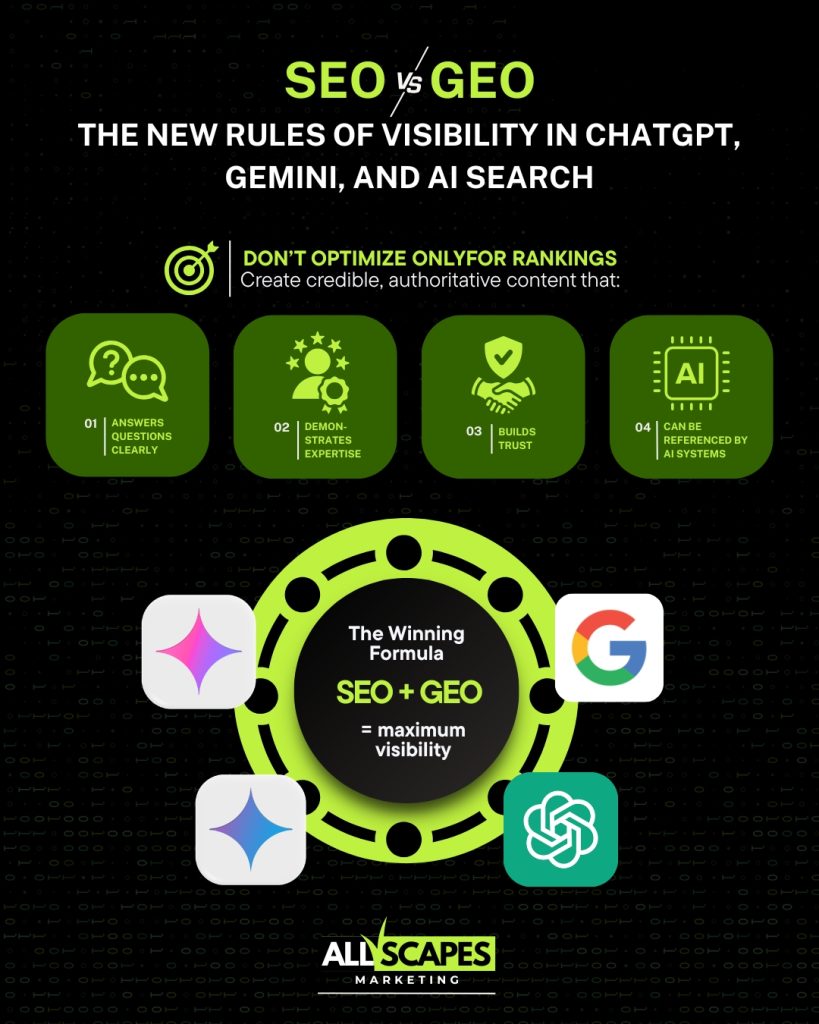
The biggest difference between SEO and GEO is how users discover information.
Traditional SEO is designed for a search experience where users browse multiple results, compare sources, and choose which websites to visit. The search engine acts as a directory, pointing people toward relevant content.
GEO supports a different experience. Instead of presenting a list of links, AI platforms analyze information from multiple sources and generate a direct answer. Users often receive recommendations, explanations, or summaries without needing to visit several websites.
Think about the difference between these two scenarios:
- A homeowner searches Google for “best artificial grass for dogs” and reviews several articles before making a decision.
- The same homeowner asks ChatGPT, “What’s the best artificial grass for dogs and why?” and receives a detailed answer immediately.
In the first scenario, visibility depends on whether your website appears among the search results. In the second, visibility depends on whether your expertise helps shape the AI’s response.
This shift changes how brands earn attention. Instead of competing only for clicks, businesses are increasingly competing to become trusted sources of information. The companies that consistently provide accurate, useful, and well-structured content are more likely to influence both traditional search results and AI-generated answers.
As search evolves, the question is no longer just, “Can people find our website?” It’s also, “Are we helping answer the questions our audience is asking?”
How AI Search Tools Choose Sources
AI search systems look for content that appears reliable, useful, and relevant. Your content has a better chance of being referenced when it includes:
- Direct answers to common questions
- Clear headings
- Expert insights
- Original examples
- Updated information
- Trustworthy citations
- Strong topical coverage
AI tools also pay attention to authority signals. If your brand is mentioned across reputable websites, directories, articles, podcasts, and industry resources, it becomes easier for AI systems to understand who you are and what you are known for.
This is why brand authority matters more than ever.
How to Optimize for GEO Without Ignoring SEO
The best content strategy does not abandon SEO. Instead, it builds on SEO and adds GEO principles.
Start by writing content that answers real user questions. Use natural language. Break topics into clear sections. Add FAQs when helpful. Explain terms simply.
Then, strengthen the credibility of your content.
You can do this by including expert commentary, customer examples, original research, case studies, and reputable sources. AI tools need information they can trust. Readers do too.
You should also build topic clusters around your main services or areas of expertise. One strong blog post is useful, but a connected library of helpful content gives both search engines and AI tools more context about your authority.
Will GEO Replace SEO?
No, GEO will not fully replace SEO. SEO is still important because search engines remain a major part of how people discover businesses, compare services, and make decisions.
Many searches still lead users to websites. Local searches, product searches, service searches, and transactional searches often depend on traditional search results.
What will change is how businesses think about visibility.
You no longer want to appear only in Google’s blue links. You also want to appear in AI-generated answers, summaries, comparisons, and recommendations.
GEO is not a replacement for SEO. It is an added layer.
How Do SEO and GEO Work Together?
SEO and GEO work best when they support each other. SEO helps your content get discovered, indexed, and ranked. GEO helps your content become clear, trusted, and useful enough to appear in AI-generated responses.
For example, a landscaping company may use SEO to rank for “artificial turf installation.” That same company may use GEO-focused content to answer questions like, “What should homeowners know before installing artificial grass?”
The SEO strategy brings people to the website. The GEO strategy helps the brand appear when users ask AI tools for advice.
Together, they create a stronger visibility system.
The Future of Search Visibility
Search is moving beyond rankings alone. Marketers and business owners need to track broader signals, such as:
Is our brand being mentioned in AI answers?
Are we creating content that answers specific questions?
Do we have enough authority around our main topics?
Are we building trust beyond our own website?
Are we publishing insights that competitors cannot easily copy?
The brands that win in AI search will not be the ones producing the most content. They will be the ones producing the most useful, credible, and clearly structured content.
If you’re ready to strengthen your presence in Google, ChatGPT, Gemini, and other AI search tools, All Scapes Marketing can help you build a content strategy designed for the future of search.
Final Thoughts
The debate around SEO vs GEO is not about choosing one strategy over the other.
SEO helps your business stay visible in traditional search. GEO helps your business stay visible in AI-powered search. Both are now part of a strong digital marketing strategy.
As ChatGPT, Gemini, and AI search tools become more common, businesses need to rethink how people find information.
The question is no longer just, “Do we rank?”
The better question is, “When AI gives someone an answer, is our brand included?”