

You can publish consistent, well-written content and still struggle with visibility.
Users no longer browse multiple pages to find information. Instead, they ask a question and expect a clear answer immediately. AI tools now deliver that answer without requiring a click, which changes what content needs to do.
You are no longer competing only for rankings. You are competing to be selected as the answer users see in AI-generated answers.
If your content does not match how users ask questions and evaluate responses, it gets ignored. This is where AEO services come in.
What Are AEO Services?
AEO services, also known as answer engine optimization, help businesses structure content so search engines and AI platforms can quickly identify and display direct answers to user questions.
Unlike traditional SEO, which focuses heavily on rankings and keyword visibility, AEO focuses on clear answers, question-based formatting, and matching real user intent.
As AI-driven platforms continue shaping search behavior, businesses that improve their AI search visibility are more likely to appear when users ask detailed, conversational questions online.
How AI Search Changed the Way People Ask Questions
Search queries used to be short because users had to work around how search engines functioned. Typing “landscaping cost” was more effective than asking a full question, since older algorithms relied heavily on keyword matching rather than understanding context.
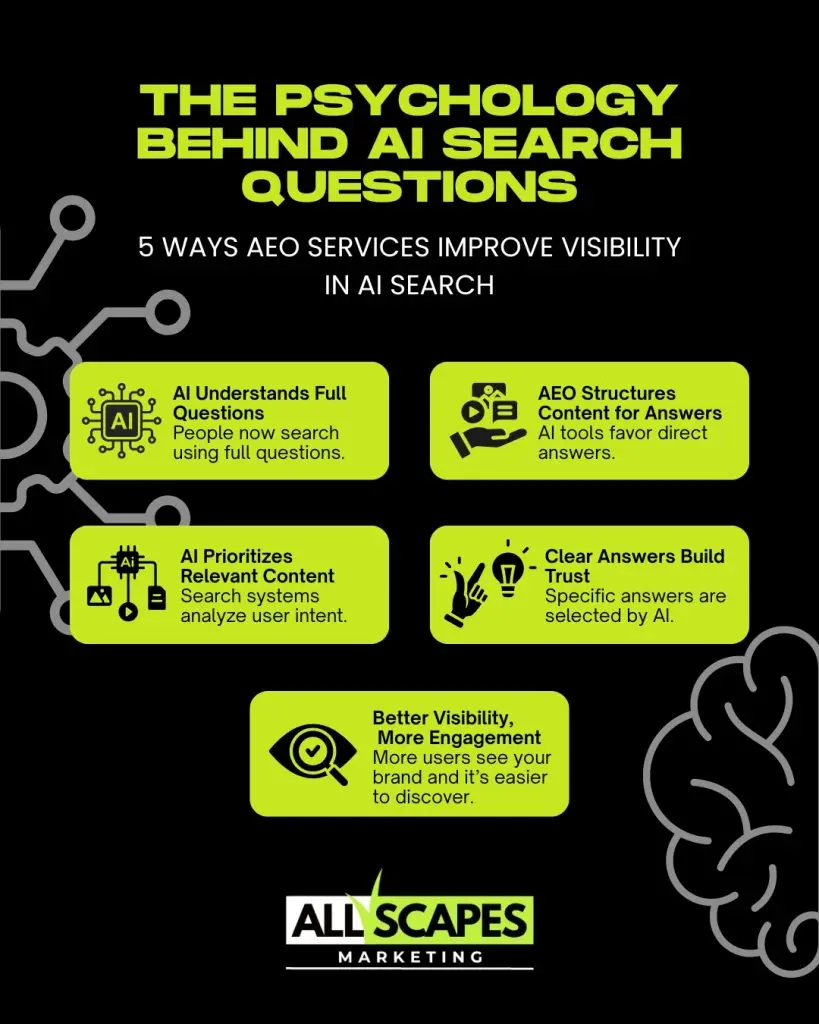
That limitation has changed. Modern search systems can interpret full questions, which has accelerated the growth of conversational search and allows users to search the way they naturally think and speak.
Today, users include context, conditions, and intent in a single query. For example, a search like “artificial turf cost” has evolved into “Is artificial turf worth it if I have pets and live in a hot area?” The second query reveals far more about the user’s situation and expectations.
Academic research supports this shift. A study published in the Journal of Consumer Research found that users provide more detailed and specific queries when using conversational or voice-based search systems. This reflects a move toward natural language interaction rather than simplified keyword input.
Further research on conversational search systems shows that modern search environments are built to support dialogue-like interactions, allowing users to express intent more clearly and receive more relevant responses.
This evolution increases the complexity of each query. Users are not just searching for information. They are describing a situation and expecting an answer that fits it.
The Psychology Behind How People Search Online
When someone searches, they are trying to get to a clear answer with as little effort as possible. That need shapes how questions are formed and why certain answers perform better than others. These patterns explain why some content gets selected as the answer while other content is ignored.
- They want immediate clarity.
Users are not looking to read through long explanations. They want an answer they can use right away. If the response is not clear within the first few lines, they move on. - They think in complete questions.
People don’t think in keywords. They think in full questions based on their situation. AI tools prioritize content that matches this natural language instead of fragmented phrases. - They decide based on trust signals.
Users quickly judge whether an answer feels reliable. Vague responses create hesitation, while specific answers reduce uncertainty. For example, saying “costs vary” is less useful than giving a clear range like “most homeowners spend between $3,000 and $15,000.”
Search Intent Includes Emotional Drivers
Search intent is often described in simple categories, but those categories do not fully explain user behavior.
Behind every query is a concern that shapes how the question is asked. A user asking about pricing is often trying to avoid overspending. A user comparing options is trying to make a confident decision. A user researching services is deciding who to trust.
These concerns influence both the structure of the question and the type of answer that feels useful.
Edelman’s Trust Barometer highlights that consumers are more likely to trust information that feels relevant to their situation, which explains why generic answers often underperform in AI search. Relevance, in this context, means addressing the actual concern behind the query, not just the topic itself.
AEO services account for this by aligning answers with both the question and the underlying decision the user is trying to make.
How AEO Services Apply This Understanding
AEO services start by identifying patterns in how questions are asked and what those questions signal. Across industries, users tend to rely on similar formats.
Questions like “How much does it cost,” “Is it worth it,” and “What is the best option” appear frequently because they reflect different stages of decision-making.
Instead of building content around broad topics, AEO restructures content around these specific questions. This changes both the focus and the format of the content.
For example, a general heading like “Benefits of artificial turf” becomes “Is artificial turf worth it for homeowners with pets?” This revision aligns the content with a real decision point, making it more relevant to both users and AI systems.
By matching how people think and ask questions, AEO services increase the likelihood that content will be selected as a response.
Structure Determines Whether Your Answer Gets Used
Even if your content answers the right question, it won’t get picked unless the structure makes that answer easy to find and use.
AI systems don’t read content the way people do. They scan for clear, direct responses they can extract quickly for inclusion in AI search results. If your answer is buried or delayed, it’s less likely to be selected.
Here’s what that means in practice:
- Put the answer at the start of the section.
The first 1 to 2 sentences should directly answer the question. Don’t lead with background or context. - Use question-based headers.
Write headers the way users ask queries. This helps AI systems match your content to real searches. - Keep answers concise and complete.
A strong answer should stand on its own in a short paragraph. Avoid vague statements or partial explanations. - Follow with supporting detail, not the other way around.
Once the answer is clear, you can expand with examples or context. The order matters. - Avoid unnecessary introductions.
Long lead-ins push the answer further down the page, which reduces your chances of being selected. - Use clear, direct language.
AI systems favor responses that are easy to interpret. Complex or indirect phrasing makes extraction harder.
What This Means for Your Content Strategy
AEO does not replace your SEO strategies. It changes how content is structured and evaluated. Keywords still matter, but they need to connect to real questions. Content must reflect how users think and how AI systems extract answers.
The most effective way to start is by reviewing your existing content.
Look at each section and consider whether it answers a specific question. Check if the answer appears within the first few lines. Evaluate whether the language reflects how a user would actually phrase the query.
If these elements are missing, the content needs to be adjusted. You do not need to create more content. You need to make your answers clearer and easier to access.
If your content is still written primarily for keyword rankings instead of direct answers, you may already be losing visibility in modern AI search results. Businesses that adapt their content for AI search visibility are more likely to appear when users ask detailed, intent-driven questions. At All Scapes Marketing, we help businesses restructure content so it delivers clear answers, aligns with real search behavior, and performs better across evolving search experiences.
Final Point
Search visibility now depends on answer quality. Users ask specific questions, and AI systems select the clearest response available. Content that does not meet both criteria is unlikely to be used.
The key question is straightforward: When someone asks a question in your space, does your content provide a direct answer, or does it require the reader to search for one?