
When you run a landscaping business, your calendar usually tells the truth before your P&L does. You feel the rush of spring when everyone suddenly wants cleanups, mulching, and fresh designs. You feel the mid-summer slowdowns when phones cool off.
That rhythm is exactly why most generic advice about “paid ads” doesn’t really fit landscapers. Most guides talk about platforms and targeting in a vacuum. But you don’t operate in a vacuum; you operate with crews, routes, equipment, weather, and neighborhoods that either make or break your profit.
Choosing the right paid advertising services isn’t about “doing more marketing.” Instead, it’s about building a predictable, profitable pipeline that matches how your landscaping business actually runs.
Why Paid Advertising Matters for Landscapers
Landscapers often come to paid ads after they’ve maxed out word-of-mouth, referrals, and yard signs. Those will always be useful. The problem is that they’re reactive. You’re waiting for someone else to talk about you.
Paid advertising lets you be proactive in three very specific ways:
- You can push when you know your capacity is about to open up.
- You can pull back when your schedule is full and focus only on higher-margin jobs.
- You can aim your efforts at specific neighborhoods and types of projects instead of taking whatever happens to show up.
Think about your last season. You probably had weeks where:
- You were booked with small jobs in far-out areas that made the days feel long and the margins thin.
- You turned away good leads because you were already overloaded.
- You had crew hours going unused at awkward times in the year.
Strategic paid advertising services give you a way to smooth some of that out. You’re not just trying to “fill the calendar.” You’re trying to fill it with the right work, in the right places, at the right times.
What are Examples of Paid Advertising?
Before you decide what’s “right,” it helps to understand what’s actually on the table. Not all channels do the same job, and that’s where a lot of landscapers get burned; they throw money at the wrong tool for the situation.
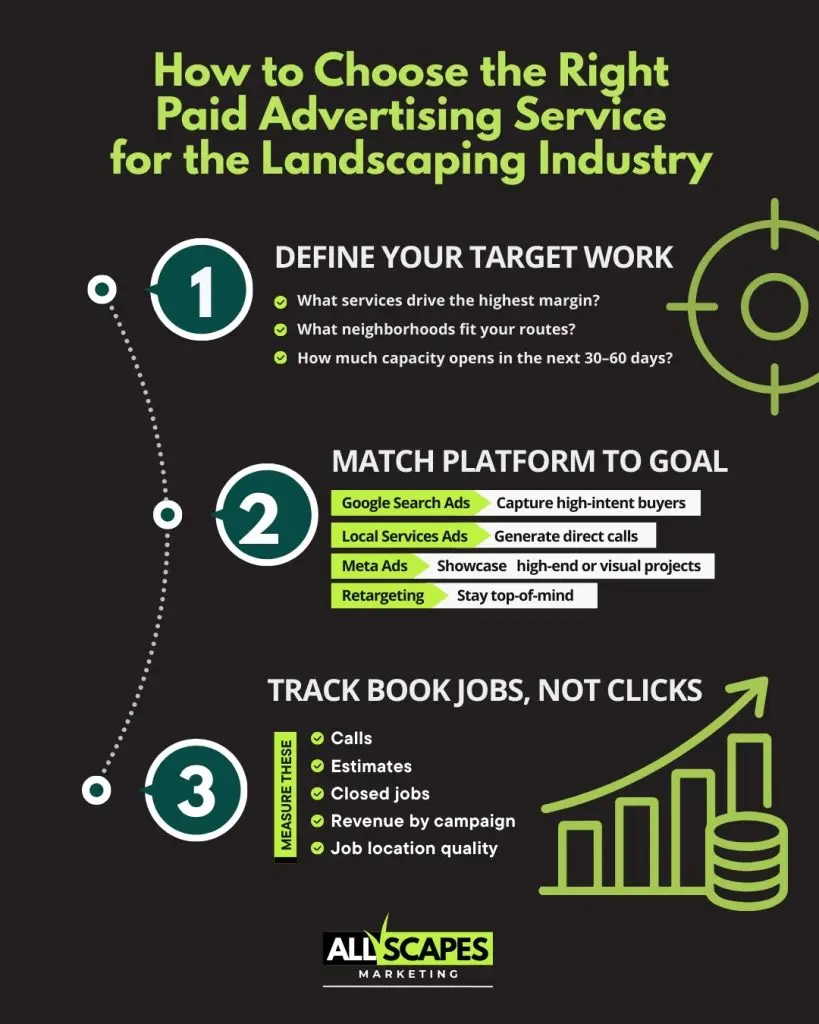
1. Google Search Ads
These are the classic text ads that appear when someone searches for “landscaper near me,” “backyard landscape design,” or “commercial landscape maintenance.”
What makes them powerful is intent. If someone is typing those terms, they’re already looking for help. For landscapers, this is usually one of the most reliable starting points because you’re stepping into a conversation that’s already happening in your customer’s mind.
Where things go wrong is when campaigns are left on “autopilot” and Google starts showing your ads for vague or irrelevant terms: “landscaper jobs,” “DIY lawn care,” “cheap yard work.” You get clicks, but they’re not buyers. That’s how budgets vanish.
The landscaping-specific twist here is negative keywords and tight geography. You don’t just care who is searching; you care where they live and whether the job type makes sense for your crews. Smart paid advertising services will protect your budget from the wrong searches and wrong areas.
2. Google Local Services Ads
If they’re available in your region, Local Services Ads (the “Google Guaranteed” style listings) can feel like a cheat code. You don’t pay per click; you pay per lead. Your reviews, service area, and verification do a lot of the heavy lifting.
These are especially useful if your team answers the phone reliably and you want the kind of lead who says, “Hi, I found you on Google, can you come out and give me an estimate?”
The nuance is in screening. If you treat every call as equal, you’ll burn time and energy chasing tiny jobs outside your preferred area. When integrated properly into your paid advertising services, Local Services Ads should be paired with clear intake questions and a willingness to say “no” to the wrong work.
If you’re considering Local Services Ads, check out our guide: The Ultimate Checklist for Partnering with a Google Local Service Ads Agency for quick tips on choosing the right partner.
3. Facebook and Instagram (Meta) Ads
Your best landscaping jobs are visual. Before-and-after photos of a backyard, a clean commercial site, or a new outdoor living space say more in two seconds than a paragraph of copy.
Meta ads shine here. You’re not waiting for someone to search; you’re putting inspiring visuals in front of people who live in the neighborhoods you care about.
Where this really becomes valuable is when you:
- Show projects that match the style and price point of your ideal clients.
- Target a tight radius around the communities you want to dominate.
- Pair the ad with a clear next step: estimate request, design consult, seasonal service offer.
Instead of “boosting posts” randomly, Meta becomes a tool to seed demand where you want your crews to work.
Retargeting and Display
A lot of homeowners quietly research landscaping companies in the background. They browse galleries at night, read a few reviews, and then get distracted. They don’t hate you. They just forget you.
Retargeting ads follow up on that quiet interest. When someone visits your site and leaves without contacting you, they’ll see your name and projects again while they browse other sites or scroll social media.
For landscapers, this is less about “selling” and more about staying in the short list. When they’re finally ready to reach out, your brand is still fresh.
Start From the Business You Want, Not Just the Ads You Can Run
Most landscapers begin with the question, “Which platforms should I use?” That’s not wrong, but it’s not the first question.
A better starting point is:
- What kind of work do you want more of this year?
- What kind of work are you trying to do less of?
- Which neighborhoods or commercial areas make the most sense for your routes?
- How much new work can your crews realistically handle in the next 30–60 days?
A design/build-focused company in higher-end neighborhoods should not run the same campaigns as a maintenance-heavy company trying to fill weekly routes. Yet many “one-size-fits-all” paid advertising services do exactly that.
When you start with your goals and constraints, you make better choices. For example:
- If you’re building recurring residential maintenance, you might lean on Google Search Ads and Local Services Ads in tight, high-value pockets, with messaging focused on reliable, ongoing service.
- If you’re targeting large design/build or outdoor living jobs, you might combine Google Search (for people actively searching) with Meta or YouTube to show your best transformations and pre-qualify budget.
You’re not just “running ads.” You’re deciding what kind of business you’re building 3–6 months from now.
Match Paid Advertising to How Your Buyers Actually Decide
Residential and commercial landscaping buyers move very differently.
A homeowner seeing weeds and overgrowth in their yard might search today and book within a few days. They’ll usually check a few websites, read some reviews, glance at a gallery, and then call whoever feels trustworthy and responsive.
A property manager, HOA, or commercial owner is slower. They’re often:
- Collecting multiple bids.
- Bringing your proposal to a board or leadership.
- Comparing vendors not just on price, but on reliability, communication, and appearance on site.
If your paid advertising services talk to both groups in the same tone and offer, you’ll confuse one or both.
This is where landing pages and messaging matter. Residential campaigns should answer questions like:
- Do these people do work that looks like my home?
- Are they nearby and responsive?
- Can I trust them not to tear up my yard or no-show?
Commercial or HOA-focused campaigns should speak to:
- Consistency, reporting, and communication
- Experience with properties similar in size and complexity
- The ability to work within schedules, compliance rules, and expectations
The platforms may be the same, but the way you use them and the way your paid advertising services are structured should respect how each buyer actually makes decisions.
Tracking What Actually Matters
You don’t need to become a data analyst, but you do need more than a monthly email saying, “You got X clicks and Y impressions.”
For a landscaping business, the meaningful numbers sound more like:
- How many calls and form fills did each campaign generate?
- How many of those turned into estimates?
- How many estimates turned into booked jobs?
- Which campaigns consistently bring in profitable work in the right areas?
This is where call tracking, tagged forms, and basic CRM usage become part of your paid advertising services. When each lead is tied back to a campaign, you can see which efforts are worth scaling and which ones are just creating noise.
Here’s the practical advantage:
Maybe you’re running two campaigns that both “look good” on the surface. But when you trace them back, one mostly feeds low-ticket, far-out jobs, while the other feeds projects on your core route with strong profit. Those two campaigns aren’t equal. You would never see that from clicks alone.
When you choose a provider, pay attention to what they promise to show you and how they talk about results. If everything stops at the ad platform and never reaches your actual booked jobs, you’re only seeing half the story.
Bringing It All Together
Choosing the right paid advertising services for your landscaping business isn’t about being everywhere; it’s about attracting the right work in the right areas at the right time. When you use ads strategically instead of randomly, they become a tool to steady your schedule, improve job quality, and grow on your terms.
If you’re ready to get more of the right landscaping jobs in the right areas, All Scapes Marketing can build a paid advertising plan tailored to your seasons, routes, and goals. Reach out today to see what’s possible for your brand.