
Search behavior keeps changing. Algorithms evolve. AI tools influence how people discover businesses online. As a small business owner, you’re expected to keep up with all of it while still running your company.
That raises a fair question: Do you actually need an SEO consultant in 2026, or can you handle it on your own?
The answer depends on your goals, your time, and how competitive your market has become. This guide breaks it down in clear terms so you can decide what makes sense for your business.
What Is an SEO Consultant?
An SEO consultant helps your business improve visibility in search engines like Google by connecting your website with people who are actively searching for the services you provide.
That sounds straightforward. However, in practice, it’s layered.
An SEO consultant evaluates how your website performs, identifies what’s holding it back, and creates a plan to improve rankings, traffic, and conversions over time.
This often includes:
- Analyzing your website structure, speed, and technical setup
- Researching keywords that your potential customers actually search
- Reviewing competitors who already rank above you
- Improving on-page content so it aligns with search intent
- Advising on content strategy, local SEO, and backlinks
In 2026, this role goes beyond keyword placement. Search engines prioritize usefulness, clarity, and trust. A consultant focuses on how your site supports real user needs, not just how it performs in tools.
If your site isn’t bringing in qualified leads, an SEO consultant looks for the reason and fixes it.
Why SEO Looks Different in 2026
Search engines now reward clarity over volume. Writing more pages doesn’t guarantee better results. Publishing AI-generated content without purpose often backfires. That’s because search results favor businesses that show expertise, consistency, and relevance.
Ask yourself this.
When someone searches for your service, does your site clearly answer their question? Or does it just exist?
An SEO consultant helps you close that gap. Not by gaming the system, but by aligning your website with how people actually search and decide.
Why Hire SEO Consultants?
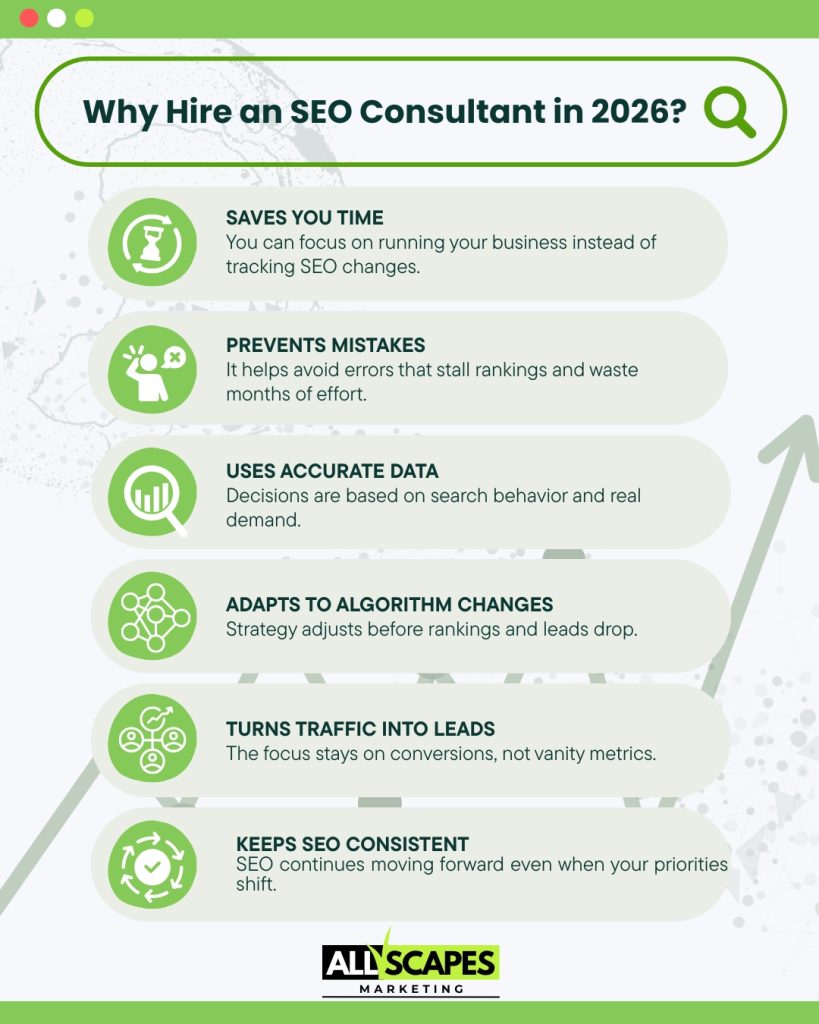
Many small business owners start SEO on their own. That makes sense. There are tools, guides, and templates everywhere. But the challenge lies in distinguishing between what matters and what doesn’t.
Here’s where SEO consultants add value.
They save you time.
You don’t have to test every tactic or chase every update. A consultant filters the noise and focuses on actions that move the needle.
They reduce costly mistakes.
Small errors can stall progress for months. Thin content, poor internal linking, or ignoring technical issues often goes unnoticed without experience.
They bring an outside perspective.
When you’re close to your business, it’s easy to assume customers search the way you think they do. Consultants rely on data, not assumptions.
They adapt to change.
Search engines will continue to evolve. An SEO consultant tracks those shifts and adjusts your strategy before rankings drop.
They connect SEO to business goals.
Traffic alone doesn’t pay the bills. A consultant focuses on leads, calls, and conversions, not vanity metrics.
If you’re asking whether SEO is “working,” that’s often a sign you need guidance.
When SEO Consultants Make the Most Sense
Hiring an SEO consultant isn’t always the right move. But in certain situations, it becomes the smarter option. Consider working with one if:
- Your website traffic has plateaued or dropped
- You rank for keywords but don’t get leads
- Competitors outrank you consistently
- You’ve invested in SEO before without clear results
- You don’t have time to learn and execute SEO properly
SEO compounds over time. Delays cost visibility. If organic search matters to your growth, waiting often creates more work later.
How to Find a Good SEO Consultant
Not all SEO consultants operate the same way. Some focus on shortcuts. Others focus on sustainable growth. Knowing the difference protects your business.
A good SEO consultant should:
- Explain the strategy in plain language
- Focus on your specific market and audience
- Set realistic expectations, not guarantees
- Share examples of past work or case studies
- Measure success using meaningful metrics
Be cautious of red flags.
If someone promises first-page rankings in a few weeks, that’s not a strategy. That’s risk.
If reports focus only on impressions or keyword counts without tying results to leads, something’s missing.
To avoid falling into these traps, ask questions early:
What will you prioritize in the first 90 days?
How do you handle algorithm changes?
How do you measure success for a business like mine?
An SEO specialist can bombard you with technical jargon, but if they can’t generate leads, they’re not helping your business. What matters is working with someone who turns search visibility into real inquiries and measurable results.
Should You DIY SEO Instead?
You can handle some SEO tasks on your own, especially early on. Basic optimization, local listings, and content updates are manageable if you have time and discipline.
The issue is scale.
SEO in 2026 requires consistency, analysis, and adjustment. Tools change. Competitors invest more. Expectations rise.
Is learning SEO the best use of your time right now? Or would that time be better spent serving customers and growing your business?
There’s no wrong answer. But there is a tradeoff.
Choosing to handle SEO yourself means progress often slows as other priorities take over. Tasks get delayed, data goes unchecked, and small issues compound over time.
Bringing in help shifts that burden off your plate, allowing SEO to move forward consistently while you focus on running and growing your business.
What Small Business Owners Often Overlook
Many small businesses assume SEO is about ranking for one or two keywords. It’s not.
In reality, search visibility is built by addressing the full range of questions, concerns, and decisions your customers have before they ever contact a business. That includes service explanations, pricing expectations, comparisons, and location-specific searches.
SEO also extends beyond content. Site speed, mobile usability, internal navigation, and credibility signals all influence whether visitors stay, trust you, and take action.
When these pieces are overlooked, traffic may increase without producing leads.
An SEO consultant helps connect these elements so your website doesn’t just attract visitors, but guides them toward becoming customers.
Is an SEO Consultant Worth It in 2026?
For many small businesses, the answer is yes, not because SEO is trendy but because search remains one of the highest-intent channels available. People searching are already looking for a solution.
The question isn’t whether SEO matters.
The question is whether you want to manage it yourself or work with someone who does it every day.
If organic search plays a role in your growth plans, getting expert guidance can shorten the learning curve and prevent costly missteps.
Final Thought for Business Owners
You don’t need to chase every marketing trend. You don’t need to overcomplicate SEO. But you do need clarity.
If your website isn’t attracting the right visitors or converting them into leads, ignoring the problem won’t fix it. An SEO consultant helps you understand what’s happening, why it’s happening, and what to do next.
Is that support something your business could use in 2026? If you’re ready to turn search visibility into consistent leads, All Scapes Marketing can help you build an SEO strategy that supports real business growth.