
If you’re in the B2B space, you already know how tough it is to get real traction online. Buyers aren’t browsing for fun; they’re comparing vendors, reading reviews, and weighing big-ticket decisions that affect their entire company.
That’s why B2B SEO strategies in 2025 have to go beyond traffic and rankings. It’s about visibility and trust, about driving actual demand, and about showing up where your buyers are, even as AI transforms how search works.
Let’s break down how to do that.
Why SEO Still Matters in B2B
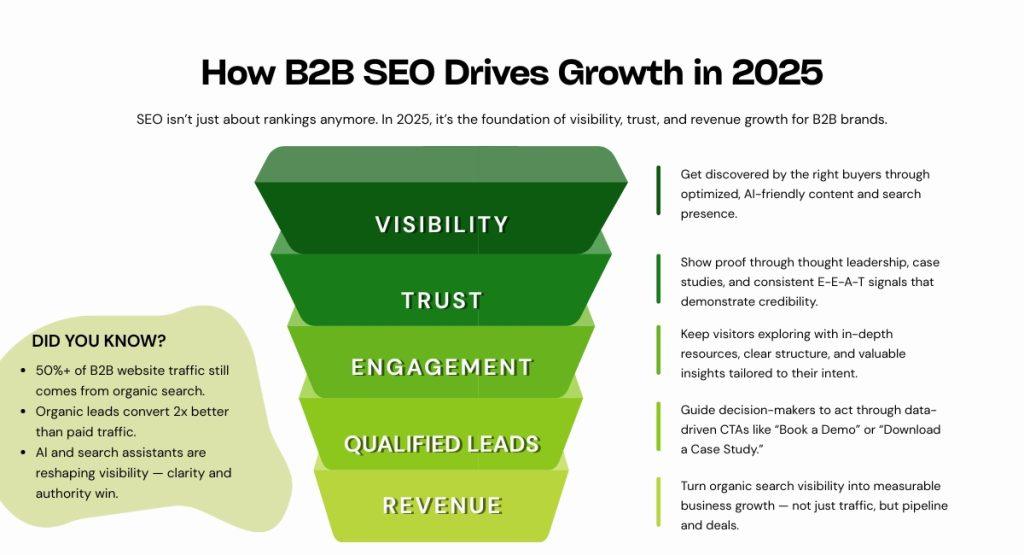
It’s tempting to think SEO has peaked, but the data says otherwise. Organic search continues to deliver more than half of total B2B website traffic, and those visitors convert better than paid ones because they’re actively looking for solutions. The catch? They’re more discerning.
These buyers are evaluating trust as much as information. They’re not just searching for vendors; they’re searching for thought leaders. And as AI-driven search tools like Google’s SGE and ChatGPT Search evolve, visibility now depends on how clearly your brand communicates authority and relevance.
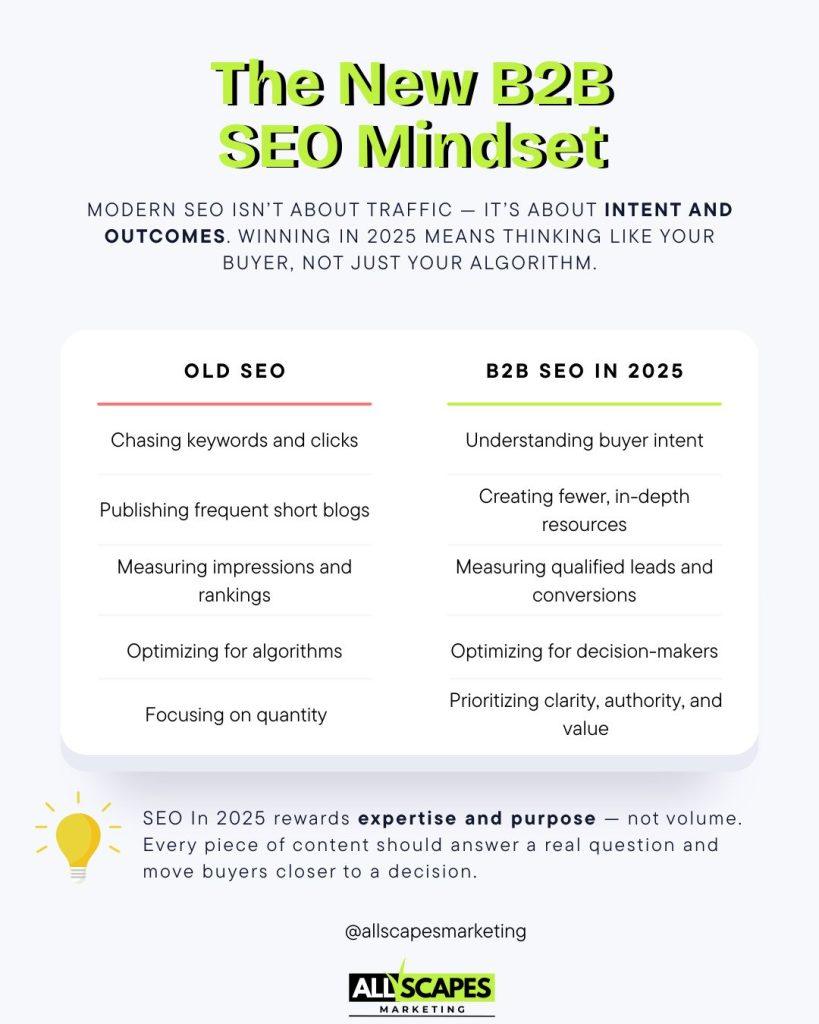
That’s why your SEO approach has to shift from keywords and clicks to outcomes and credibility.
Start With Demand, Not Traffic
The first mindset change is simple but powerful: stop chasing pageviews and start capturing intent. Your audience isn’t browsing aimlessly; they’re trying to solve specific business problems. To connect with them, you need to understand who they are and what motivates their search.
Think about the people you actually want to reach. Maybe it’s a procurement lead researching cost-saving tools or a CTO comparing integration options. Each one uses search differently. The more you align your content with those nuances, the better your results.
Instead of pumping out surface-level blog posts, focus on depth and clarity. Build your website around major topics that reflect your expertise, each supported by detailed, useful subtopics. This structure helps search engines grasp what your company does best and keeps potential clients engaged longer.
And when visitors arrive, make the next step obvious. Calls to action like “Schedule a demo” or “Download our case study” turn interest into measurable results. SEO should feed your sales funnel, not just your analytics dashboard.
Build Trust Like a Real Partner
In B2B, authority is the currency that drives every deal. The companies that win search visibility are usually the ones that demonstrate proof, not just polish.
Case studies, testimonials, and industry insights all reinforce your credibility. The goal isn’t to boast but to show that you’ve delivered real outcomes. Publishing data-driven results or lessons from client projects builds confidence among decision-makers who are looking for reliable partners.
Backlinks still matter, but quality trumps quantity. Relevance is key—links from industry publications, associations, or partners signal legitimacy far more than generic guest posts.
Google continues to reward content that reflects Experience, Expertise, Authoritativeness, and Trustworthiness (E-E-A-T). That means including author bios, showcasing credentials, and making your brand’s expertise easy to verify. When your website looks credible to both humans and algorithms, your rankings follow naturally.
Prepare for AI-Powered Search
AI has changed how people find information. In 2025, users might never click a link; they could get their answer directly from an AI-generated summary. But that doesn’t mean SEO is obsolete. It means your strategy needs to evolve.
You can make your content AI-friendly by writing in a natural, conversational tone that reflects how people actually ask questions. Structured, easy-to-scan content helps too. Clear subheadings, short paragraphs, and well-labeled data make it easier for AI systems to understand and reference your information.
Adding FAQ sections or embedding answers to common questions within your articles improves your visibility in voice and AI search. Think of your content as a trusted data source that answer engines can draw from.
And don’t neglect the basics. Page speed, mobile usability, and technical SEO still matter. AI systems rely heavily on well-structured, accessible sites when selecting content to display. In short: the cleaner your site, the more likely it is to surface when it counts.
Measure What Really Drives Revenue
Many marketing teams still measure SEO by rankings or impressions. That’s a mistake. In B2B, you need to connect SEO directly to business outcomes.
Start by tracking the right metrics: qualified leads, lead-to-opportunity conversions, and the revenue tied to organic traffic. Integrate your CRM with analytics so you can see which search terms and pages actually drive deals, not just visits.
This clarity changes how you allocate effort. You might find that a single, low-volume keyword tied to your core service generates far more revenue than high-traffic informational content. With the right data, you can double down on what converts instead of what merely attracts attention.
Avoid the Traps That Waste Time
Even experienced marketers fall into familiar traps. Some treat B2B SEO like B2C, chasing volume instead of value. Others publish blogs just to stay active without offering real insight. And too many teams ignore technical SEO while obsessing over keywords.
The result is predictable: more traffic, fewer leads.
A good rule of thumb is to ask, “Would a serious buyer find this useful?” If the answer’s no, it’s not worth publishing. Quality and relevance beat quantity every time.
A Smarter Way Forward
The future of B2B SEO isn’t about chasing algorithms. It’s about understanding your audience and earning their trust through clarity, proof, and value. When your content genuinely helps decision-makers make better choices, you win both in rankings and revenue.
AI and automation will keep changing the way search works, but the fundamentals remain the same. Businesses buy from brands they trust, and trust is built through visibility, consistency, and expertise.
At All Scapes Marketing, we believe SEO is more than a channel; it’s a growth engine. The strategies that work in 2025 aren’t just about being found; they’re about being chosen. If you’re ready to build an SEO plan that turns search visibility into sales conversations, we’re here to help.