Most lawn care companies start marketing when the phone stops ringing in spring. By then, the best customers in your service area have already said yes to someone else. The owners who start the season with full routes did their selling in November, December and January.
Winter is when lawn care marketing pays off the most. Your current customers are easy to reach, your competitors have gone quiet, and homeowners have time to think about next year. At All Scapes Marketing, we spend these months helping landscaping and lawn care companies lock in renewals, fill route gaps and get their websites and ads ready before the spring rush.
This guide gives you a month-by-month plan you can start this week, plus the rules you need to follow when you email or text customers.
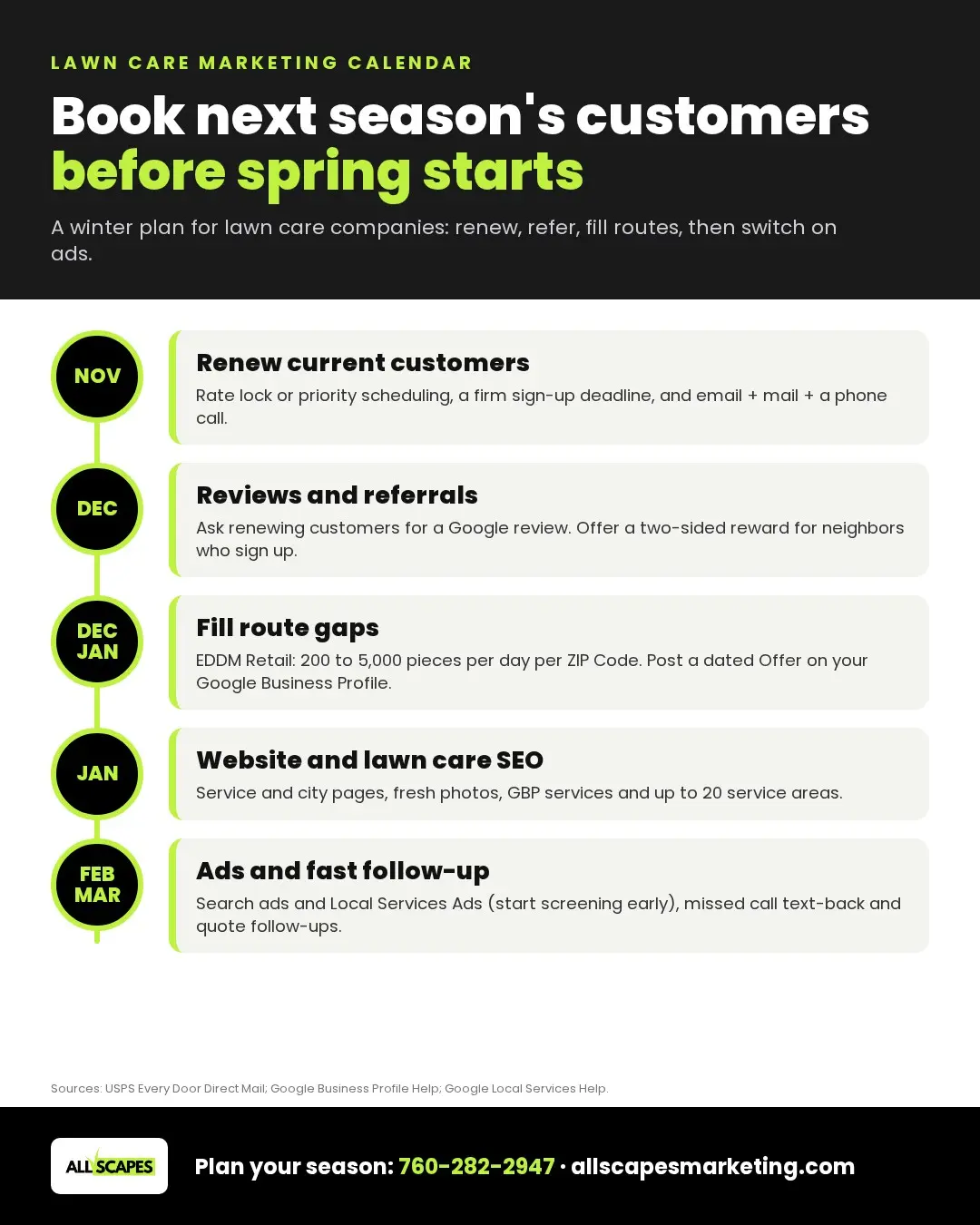
Quick Answer: Your Winter Lawn Care Marketing Plan
| When | Focus | What to do |
|---|---|---|
| November | Renew current customers | Send renewal agreements with a rate lock or priority scheduling and a firm sign-up deadline |
| December | Referrals and reviews | Ask happy customers for reviews and referrals, and offer a reward for neighbors who sign up |
| December to January | Fill route gaps | Mail or door-hang the streets around your densest stops, and post an Offer on your Google Business Profile |
| January | Website and lawn care SEO | Update service and city pages, photos, services and service areas before homeowners start searching |
| February to March | Ads and follow-up | Launch search ads and Local Services Ads, and make sure every call and form gets a fast reply |
Why Is Winter the Best Time for Lawn Care Marketing?
Lawn care is a route business. Every new lawn that sits on an existing route adds revenue without adding much drive time. Every lawn across town adds fuel, labor and windshield time. When you sell in winter, you choose where your new customers come from. When you sell in spring, you take whoever calls.
Booking early also helps you plan crews. The U.S. Bureau of Labor Statistics projects about 162,500 openings for grounds maintenance workers each year through 2035, mostly to replace workers who leave the field. Hiring is a constant challenge, so knowing how many stops you have sold by February tells you how many people to hire and when.
There is one more reason: attention. In winter, there are fewer lawn care ads, fewer door hangers and fewer posts competing with yours. A homeowner who hears from you in December is not comparing you with five other companies yet.
Step 1: How Do You Renew Lawn Care Customers Before Spring? (November)
Your easiest new season sale is a customer you already have. Before you spend a dollar on new leads, get as many current customers as possible signed for next year.
Build a renewal offer people can say yes to
You do not need a deep discount. Most customers care about certainty and convenience. Pick one or two of these:
- Rate lock: sign by a set date and keep this year’s price for next season.
- Priority scheduling: renewed customers get the first spring cleanup and first mowing slots.
- A simple package: spring cleanup, fertilization and weed control, aeration and a mowing program at one price.
- Prepay option: a small incentive for paying the season up front, if it helps your cash flow.
- Add-on credit: a free edging pass or a reduced first application when they sign.
Put a real deadline on the offer, such as December 15, and stick to it. A deadline gives customers a reason to decide now instead of “sometime before spring.”
Send it in more than one way
Send the renewal by email, follow up with a printed letter or postcard, and have the office call anyone who has not answered by the deadline week. Make signing easy: one link, an e-signature or a quick reply.
Follow the rules for email and texts
Marketing emails and texts are covered by federal rules, so check these before you hit send:
- Email: the Federal Trade Commission’s CAN-SPAM compliance guide says every marketing email needs an accurate subject line, your valid physical postal address and a clear way to opt out. You must honor opt-out requests within 10 business days.
- Texts: the Federal Communications Commission says commercial texts sent with an autodialer require the recipient’s written consent. Add a consent checkbox to your estimate form and service agreement now, so your spring reminders are covered.
Owner tip: Look at last season’s cancellations before you send anything. A customer who left because of a missed visit needs a phone call, not a promo email.
Step 2: Turn Happy Customers Into Reviews and Referrals (December)
Your existing customers live in the exact neighborhoods you want to grow in. That makes them your best lawn care lead generation source.
Ask for reviews while the season is fresh
Ask every customer who renews for a short Google review. Send a direct link, mention one thing they can talk about (on-time visits, a greener lawn, a clean cleanup), and reply to every review you get. Reviews you collect in December are on your profile when new homeowners start comparing companies in late winter. Our guide on how to get more reviews for your landscaping business has scripts you can copy.
Make referrals specific
“Tell your friends” rarely works. A specific ask does:
- “We have room for two more lawns on your street on Tuesdays. If a neighbor signs up by January 31, you both get a free spring edging.”
- Put the same offer on your invoice, your renewal letter and a card your crew leaves after the last fall visit.
- Track who referred whom, and pay the reward quickly so customers see it is real.

Step 3: How Do You Fill Route Gaps With Neighbor Marketing? (December to January)
Once renewals are in, map your routes. Look for streets where you already service several lawns and for gaps between stops. Those are the homes worth marketing to first.
Direct mail and door hangers around your best stops
Every Door Direct Mail from the U.S. Postal Service lets you mail a postcard to every address on a carrier route without buying a list. With EDDM Retail, you can send at least 200 and up to 5,000 pieces per day per ZIP Code, and USPS lists retail postage at $0.26 per piece at the time of writing (check current prices before you print). Door hangers on the streets around your densest stops do the same job without postage.
Keep the message simple: who you are, the services you offer, a “neighbor” offer with a deadline, real photos of lawns you maintain and one clear way to book.
Post a Google Business Profile Offer
Your Google Business Profile lets you publish posts, including an Offer post with a title, start and end dates and a “View Offer” button. Google notes in its Business Profile posts help page that posts older than six months are archived unless a date range is set, so give your early booking offer clear dates that match your deadline.
What Lawn Care SEO Work Should Happen Before Spring? (January)
Homeowners search before they call. If your website and Google Business Profile are not ready when they start looking, your mailers and ads send them to a weak first impression. January is the month to fix that.
Website checklist
- One page per core service: mowing, fertilization and weed control, aeration and overseeding, cleanups. Each page should explain what is included, how often, and how to get a quote.
- City or area pages: a useful page for each main town you serve, with local photos and the services you offer there. Our local SEO guide for landscaping businesses explains how to build these without thin, copy-paste content.
- A quote form that works on a phone: test it yourself. Call your own number and submit your own form.
- Fresh proof: add this season’s best photos and recent reviews.
- Seasonal content: a spring cleanup page or blog post published in January has time to get indexed before people search for it.
Google Business Profile checklist
- Check your categories and add every service you offer through Edit services.
- If you are a service-area business, Google’s service area help page says you can list up to 20 areas by city or ZIP code, and your overall area shouldn’t be more than about 2 hours of driving time from where your business is based. List the areas you actually want to work in.
- Upload new photos of real crews, trucks and lawns, and update your winter and holiday hours.
If you want a team to handle this for you, see our landscaping SEO services.
Should You Run Lawn Care Ads in Winter? (February to March)
Paid ads are the fastest way to fill the remaining gaps once renewals and referrals are in. Timing and setup matter more than budget.
Google search ads
Start search campaigns before the spring peak so your ads, keywords and conversion tracking are tested when demand climbs. Target your best ZIP codes first, send each ad group to the matching service page, and add negative keywords for services you don’t offer.
Don’t lean on seasonality adjustments to handle spring. Google’s seasonality adjustments help page says they’re best for short events of 1 to 7 days, may not work as well for more than 14 days, and Smart Bidding already accounts for seasonal changes. Use them for a short promotion, like the last few days before your booking deadline, not for the whole season.
Local Services Ads
Google lists lawn care as a Local Services Ads category, covering lawn installation and maintenance such as weed control, mowing and seeding. In some categories and locations, Google requires background checks for the business, the owner and field workers, and that can take time. Start the screening in winter so you’re approved before spring. Learn more about our Local Services Ads management and PPC services for landscapers.
How Do You Make Sure Every Spring Lead Gets Booked?
The first warm week of spring brings a flood of calls and forms. Leads that wait hours for a reply often book with whoever answers first. Set up your follow-up in winter, while you have time:
- Missed call text-back: an automatic text when you can’t answer, so the caller knows you’ll get back to them.
- Instant form replies: a confirmation that tells the homeowner what happens next and when.
- Follow-up sequence: reminders for quotes that haven’t been accepted after 2, 5 and 10 days.
- Booking link: let qualified leads pick an estimate time without phone tag.
- Lead source tracking: record whether each customer came from a renewal, referral, mailer, search or ad, so next winter’s budget goes to what worked.
Our CRM automation for landscapers includes these tools, and our post on automating lead capture and follow-up walks through the setup.
10 Lawn Care Marketing Ideas for the Off-Season
- Send renewal agreements with a rate lock and a deadline.
- Call last season’s cancellations and ask what went wrong.
- Offer a two-sided referral reward for neighbors.
- Ask every renewing customer for a Google review.
- Mail or door-hang the streets around your densest routes.
- Publish a Google Business Profile Offer with clear dates.
- Refresh service pages and add one page per main town.
- Publish a spring cleanup or aeration page in January.
- Start Local Services Ads screening early.
- Set up missed call text-back and quote follow-up before the first warm week.
Booking Numbers to Watch This Winter
You don’t need a complex dashboard in the off-season. Track these four numbers every two weeks:
- Renewal rate: customers signed for next season divided by customers you serviced this year.
- Pre-booked revenue: the total of signed agreements, compared with your target for opening day.
- Route density: stops per route day, and how many new lawns sit within your current routes.
- New sign-ups by source: referral, mail, Google Business Profile, search or ads.
These tell you early if you need to push referrals harder or start ads sooner.
Should You Do It Yourself or Hire a Lawn Care Marketing Agency?
Many owners can handle renewals and referrals in-house because they know their customers best. The work that usually benefits from a specialist is the technical side: SEO, ad campaigns, tracking and automation, where setup mistakes cost money all season.
If you’re comparing partners, our guide on how to choose a landscaping marketing agency lists the questions to ask before you sign. For more ways to bring in work, see how to generate landscaping leads with these strategies.
Frequently Asked Questions
When should a lawn care business start marketing for spring?
Start in November with renewals for current customers, then move to referrals, neighbor mailers and website updates through December and January. Launch or scale paid ads in February and March, before the spring rush.
What is the best marketing for a lawn care business?
For most lawn care companies, the best return comes from current customers first: renewals, reviews and referrals. After that, a strong Google Business Profile, a website with clear service pages, and search ads or Local Services Ads bring in new homeowners.
Should I offer a discount to pre-book lawn care customers?
Not always. A rate lock, priority scheduling or a free add-on often works as well as a discount and protects your margins. Whatever you offer, give it a firm deadline.
Can I text my lawn care customers about specials?
Only with the right consent. The FCC says commercial texts sent with an autodialer require the recipient’s written consent, so collect it on your estimate form and service agreement before you send marketing texts.
Is lawn care SEO worth it for a small company?
Yes, if you serve a defined area and want steady leads without paying for every click. SEO takes time to build, which is why January is a good time to update your service and city pages before homeowners start searching.
Book Next Season Before Your Competitors Do
The lawn care companies that start spring with full routes do their selling in winter. Renew your current customers in November, turn them into referrals in December, fill your route gaps in January, and have your website, ads and follow-up ready before the first warm week.
All Scapes Marketing has spent more than 10 years marketing landscaping and outdoor service businesses. If you want help building your lawn care marketing plan for next season, call us at 760-688-2119 or schedule a strategy call with All Scapes Marketing.